Rural Colorado Needs School Choice Too
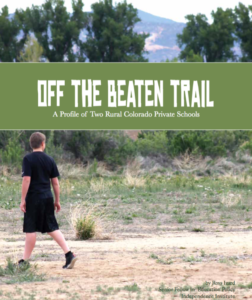
Rural towns face unique difficulties and therefore require unique solutions in their communities, and education is no exception.
Read More...
Rural towns face unique difficulties and therefore require unique solutions in their communities, and education is no exception.
Read More...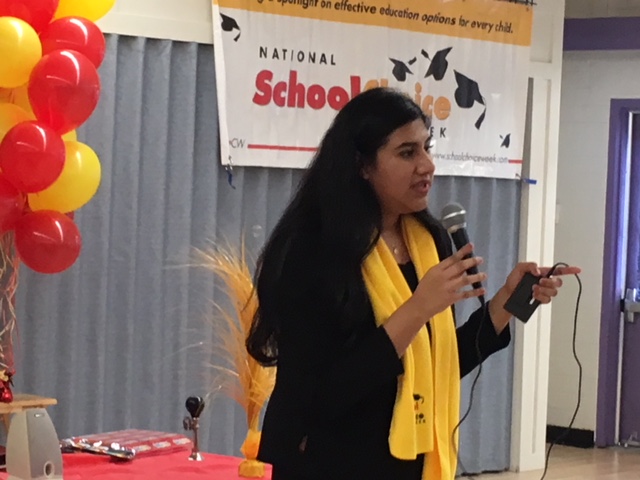
During National School Choice Week, the youngest member of the Independence Institute Education Policy Center’s team, Arrupe Jesuit High School Junior, Diana De La Rosa, had her first op-ed published in a Colorado newspaper.
Read More...Yesterday marked the beginning of the 2018 National School Choice Week, one of the most fun and joyful weeks of the year for us school choice supporters. Throughout the course of this week, there will be gatherings, speeches, parades, and numerous other events held to celebrate all forms of choice in education. In Colorado specifically, there we be a variety of events held around the state. My friends at the Independence Institute and their partner organizations are holding an event in Denver on Saturday for families to celebrate school choice and to learn about scholarship organizations that help low-income children attend private schools. You are welcome to join us! In Colorado Springs, our friends from Parents Challenge have organized an event at City Hall on Wednesday. They would love to see you too! This week, it’s important to remember that school choice is about giving every child the opportunity to succeed and reach their best self–not political partisanship. There is no one universal truth or omnipotent solution in education; each option provides a distinguished benefit or focus that may or may not be the best fit approach to teaching a particular student the critical thinking and academic skill set they […]
Read More...I misinterpret things my mom tells me to do all the time. Somehow “pick up your toys” sounds a lot like “go watch T.V.” when my favorite show is on. Those phrases are interchangeable to me. But, treating words that aren’t synonyms as interchangeable can have consequences–as I find out when my mom catches me watching Nickelodeon instead of doing my chores. In recent years, the meaning of sectarian has been conflated with the meaning of religious–especially in the debate surrounding Blaine Amendments. In his article in the Federalist Society Review, “Why Nineteenth Century Bans on ‘Sectarian’ Aid Are Facially Unconstitutional: New Evidence on Plain Meaning,” the Independence Institute’s constitutional jurisprudence expert Rob Natelson defines the critical difference between “sectarian” and “religious,” and the consequences this misinterpretation has led to in private school choice. Mr. Natelson’s article is comprised of three primary sections that support his claim: 1. Nineteenth Century Constitutional Provisions Show that “Sectarian” Had a Meaning Separate from “Religious” or “Denominational” This section focuses on the drafting of state constitutions and how the terms religious, denominational, and sectarian are used separately. Each has a distinguished meaning and are not used interchangeably in their respective clauses. 2. The Nineteenth […]
Read More...To start off the New Year, Wisconsin legislators have introduced an education saving account (ESA) bill for gifted and talented, low-income families in an effort to aid gifted students who are less likely to receive recognition and support. Two-thousand low-income students will have access to an ESA, with a limit of $1,000 that can be used for additional education services. While I fill my piggy bank up with money for candy and Legos, these families will be able to fill their account with tax-exempt funding for AP testing and college courses. There are an estimated three million K-12 students in the U.S. who are considered gifted. While we have a federal savings fund for students with learning disabilities, we lack a savings option for our gifted students. I think it’s time we acknowledge that there are students whose promise is being overlooked and potential underutilized and give them the opportunity to reach their best–Wisconsin’s proposal may prove to be a critical step in doing so. In a recent op-ed published in the Washington Examiner titled Is school choice 2.0 coming?, the authors clearly define how our education system undermines gifted students’ education: “Mass education presents a difficult balance for teachers, […]
Read More...I recently took a road trip to California for the holidays. I passed through Silicon Valley, and boy was there some cool stuff to see–the most interesting thing? Well, aside from the Winchester Mystery House and people wearing scarves in 70-degree weather, I marveled at the sight of a 43 million-dollar public charter school campus being built into the side of a behemoth tech company. Oracle, a computer software company based out of California, is just finishing the construction of a new campus designated to Design Tech High School. The campus will be integrated into Oracle’s estate, placing 550 students and an enormous tech company in a shared proximity. Design Tech is a public charter school that emphasizes STEM courses and Stanford Universities’ design thinking. Now, it will act as a leading model for partnerships between technology companies and public education. Students at Design Tech will not only benefit from the brand new high-tech campus gifted by Oracle, but also from the opportunity for internships and mentoring from their neighboring organization. The price that Oracle is charging for rent? One dollar per-year. Even I could afford that with my allowance. While some are concerned that Oracle may exercise excessive power […]
Read More...As more innovative education models emerge, school districts must adapt and provide competitive education options to retain students, or face the threat of diminishing enrollment. The Jefferson County school district is currently encountering this exact problem. In recent years, it has seen a declining trend in enrollment–largely due to the emergence of nearby “choice” schools. To combat the loss of students to innovative schools such as the Denver School of the Arts, Jeffco has begun the conceptualization and appraisal of a new, specialized art school for the district. The “arts academy” would be a terrific effort to integrate more choice into the district, and to allow students to pursue “customized pathways.” I wonder if it’ll have a finger-painting class? The district is also considering reconstructing one of its existing schools, Pennington Elementary. The renovation would likely incorporate an expeditionary education model; however, an expeditionary model is not a set-in-stone solution. Though the school is open to the idea and has shown excitement, there is still time and opportunity for other proposals. In a recent article, Chalkbeat Colorado noted that the “[Jefferson County] officials said they want to have a searchable site where families can enter a program-type they are interested in to […]
Read More...It’s no secret that people don’t love Pearson’s PARCC tests. Even way back in 2015, states were practically tripping on themselves trying to get away from the unpopular test, which was originally designed to provide comparable results across state lines. That trend has continued, and only a handful of the original dozens of PARCC states remain. Now, it looks like Colorado is jumping ship. It’s about time. But are we really leaving PARCC behind? Or are we just witnessing a rebranding effort? Colorado’s experience with PARCC has not been overly pleasant. For starters, and although there have been some improvements on this front, results have been slow to roll in despite promises from test-making giant Pearson Education that their technology would make those results available faster. It’s hard to do much with test scores that come in after the new school year is already in full swing. That makes it very tough to create buy-in on the part of educators, parents, or even education observers. PARCC has similarly failed to convince students and parents of its value, and opt-out numbers have soared. Those opt outs are a serious problem for a number of reasons. First, they signal that the state […]
Read More...This week is a big week in the world of education law. Today, the U.S. Supreme Court will take up its first case related to state constitutional Blaine clauses. We talked about these ugly little pieces of constitutional language in some detail last week when I highlighted the Independence Institute’s new paper, Blaine’s Shadow: Politics, Discrimination, and School Choice. Check out that paper if you need some historical background on Blaine clauses and what they mean for education today. Before you ask, the court isn’t considering the Dougco voucher case tomorrow. We’re still waiting to find out whether SCOTUS will hear that one. Instead, the high court will hear oral arguments in Trinity Lutheran v. Pauley, which deals with a Blaine-related case out of Missouri. We’ve talked about that case in passing over the year or so since I wrote about it in detail, but a refresher is probably in order. From my previous post: Here’s the skinny: Missouri runs a program under which organizations can apply to the state for grants. That’s not unusual. But here’s the trick: these “grants” do not come in the form of money. They come in the form of scrap rubber. That rubber is used […]
Read More...James G. Blaine. You’ve heard that name before, right? Of course you have. I’ve written about Congressman Blaine a number of times, usually in the context of Douglas County’s ongoing legal battle against so-called “Blaine Amendments” through its first-of-its-kind local voucher program. Or maybe I should say programs (plural), as the district’s other voucher program made things pretty complicated for a while before a debatable court decision and a new decision by the board put an end to most of the legal craziness. But while we’ve talked a fair amount about Blaine and the state constitutional clauses named after him, I’m not sure we’ve ever really known the full story. There’s a lot of important history and drama and politics buried behind the simple narrative that most folks just don’t know. Ross Izard, my favorite policy nerd, set out to tell that story—and to explain why it matters from a constitutional perspective—in his most recent issue paper, Blaine’s Shadow: Politics, Discrimination, and School Choice.
Read More...
